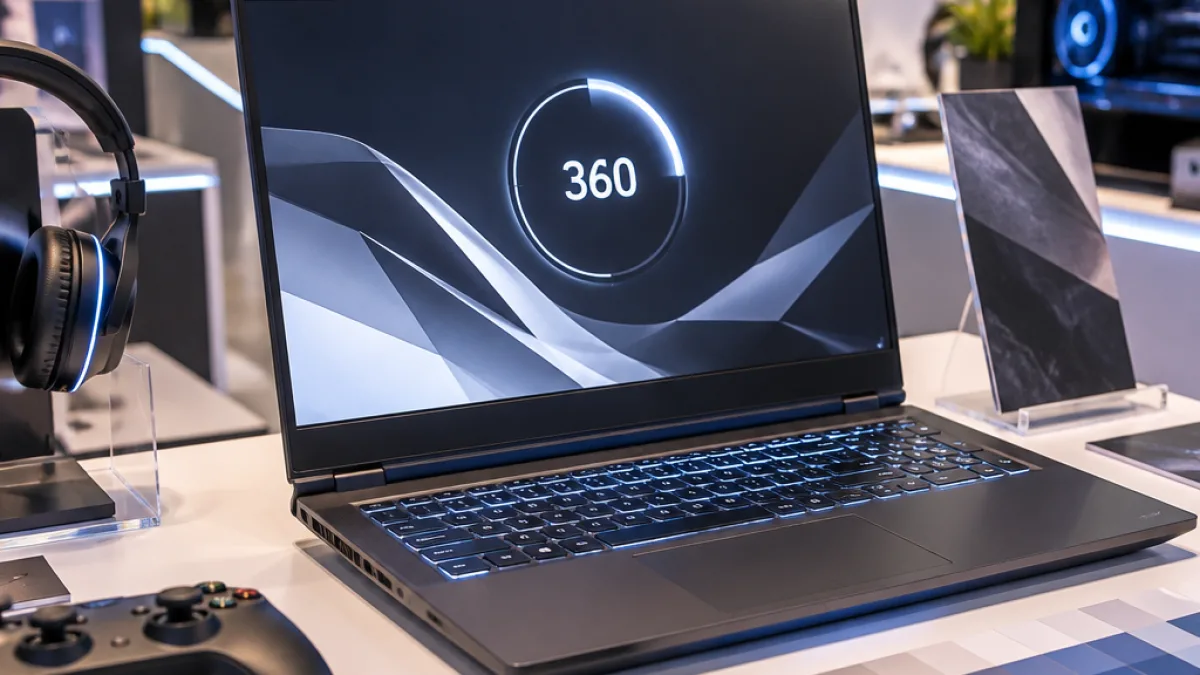
TCL CSOT has demonstrated a 16-inch OLED panel with a 360 Hz refresh rate inside a Lenovo Legion gaming laptop prototype, putting the display maker ahead of the 300 Hz notebook OLED panel Samsung introduced in August 2026. The demonstration took place at TCL CSOT’s DTC 2026 event and was presented as the company’s highest-refresh-rate notebook panel so far.
The panel uses a 2560 × 1440 resolution, covers 100% of the DCI-P3 color space and reaches a rated peak brightness of 500 nits. It is produced using inkjet printing, a manufacturing method that deposits liquid organic material directly into defined subpixel trenches. TCL CSOT says this process can reduce production costs and improve text sharpness compared with conventional OLED manufacturing.
A faster panel for future gaming notebooks
The prototype represents a substantial increase over the company’s earlier 240 Hz inkjet-printed OLED panel, which TCL CSOT supplied for Lenovo’s Legion R9000P earlier in 2026. The newer panel also exceeds Samsung’s 300 Hz OLED notebook display, announced at 2.5K resolution in August 2026.
| Specification | TCL CSOT prototype panel |
|---|---|
| Screen size | 16 inches |
| Resolution | 2560 × 1440 |
| Refresh rate | 360 Hz |
| Color coverage | 100% DCI-P3 |
| Peak brightness | Up to 500 nits |
| Panel type | Inkjet-printed OLED |
For players, a 360 Hz display is primarily aimed at fast-paced games where motion clarity and responsiveness are important. However, reaching the panel’s full refresh rate would require a notebook to render up to 360 frames per second at 1440p, a demanding workload for mobile graphics processors. The display’s maximum refresh rate therefore does not mean every game or laptop configuration will operate at that rate.
- The prototype combines 1440p resolution with a 360 Hz refresh rate.
- TCL CSOT says inkjet printing could support lower-cost OLED production and sharper text.
- Lenovo has not confirmed a retail Legion laptop using the panel.
Mass production is not a retail announcement
A TCL CSOT executive said the company is working with partners and that mass production could begin soon. That statement indicates a possible path beyond the demonstration unit, but it does not establish when a finished laptop will be announced or shipped.
Lenovo has not confirmed whether the Legion prototype will reach stores. TCL CSOT has also not disclosed a release date, price or final hardware configuration for the laptop shown at DTC 2026. As a result, there is currently no confirmed Philippine or Southeast Asian availability for a Lenovo Legion system using this 360 Hz OLED panel.
The technology arrives as notebook manufacturers continue to use high refresh rates as a differentiator in premium gaming systems. TCL CSOT’s earlier 240 Hz panel already appeared in a Legion model, while this prototype raises the ceiling to 360 Hz. The company’s longer-term challenge will be producing the panel at scale while maintaining its stated specifications and keeping manufacturing yields viable.
The demonstration also places TCL CSOT in more direct competition with Samsung and LG Display in the OLED notebook market. Desktop gaming monitors have already moved beyond notebook refresh rates, with some models exceeding 1,000 Hz, but bringing a 360 Hz OLED panel to laptops would narrow part of that gap if the technology reaches commercial hardware.